Who Are You?
Everyone thinks they know. Almost no one does. Society's wicked problems have been studied from the outside in for decades, yet they persist because the interior states that actually drive every vote, purchase, and commitment remain only coarsely mapped by existing methods. Classical models show important limitations because polls and surveys "measure the collapse, not the state."
The Belief Genome Project (BGP) is a measurement architecture designed to map that interior landscape. By synthesizing decades of cognitive science and quantum probability, the BGP provides an empirical framework to measure human contradiction not as an error, but as a feature of a highly complex mind.
The Heritage
The limits of the rational actor.
Research on decision making draws on work from the 1940s by John von Neumann and Oskar Morgenstern. Their classical model described people as rational actors. BGP contrasts this ideal with the uncertainty and context that can shape real choices.
However, as behavioral science advanced, researchers like Amos Tversky and Daniel Kahneman demonstrated through their heuristics and biases program that humans systematically violate the basic laws of classical probability. As illustrated by their famous "Linda problem," we do not simply make random errors. People often give responses that appear contradictory under classical probability assumptions. The classical model provided a vital foundation, but it lacked the mathematical language to explain this dynamic contradiction.
A Heritage Timeline
The intellectual lineage that prepares the ground for the Belief Genome Project. Hover any milestone to read the contribution it made.
Scroll horizontally to explore the full timeline.
The Quantum Grammar
A new mathematical vocabulary.
The Belief Genome Project draws on quantum cognition research of Jerome Busemeyer and Peter Bruza. Their work and subsequent developments show that quantum probability can model superposition, interference, and non-commutativity. These concepts can capture context effects and judgment patterns that classical probability struggles to model.
Researcher David Edwin Meyers uses the analogy of a full color wheel. When a 12-color wheel spins at high velocity, the individual colors optically mix into a dynamic, vibrating gray. In much classical survey practice, a midpoint response (like a 5 out of 10) is often interpreted as apathy or indecision. Inspired by quantum-cognitive models, the BGP instead treats the midpoint not as a single state but as a convergence zone for several distinct ones that classical scoring cannot tell apart: a genuine, indeterminate superposition (a belief not yet resolved), a definite contradiction (two competing convictions held at full strength at once), and the empty middles of apathy and ignorance. The "vibrating gray" of the spinning wheel captures the engaged, cases of strong conflict. The measure is designed to distinguish them from these empty middles. To explore this empirically, the BGP introduces the Entropy State Slider as a proposed measurement device aimed at quantifying the degree of perceived uncertainty and conflict rather than forcing a single binary choice.
The Macro Scale
Society as a quantum field.
At the macro level, we draw on Andrei Khrennikov's Social Laser Theory and related mean-field models. These use quantum mathematics as a modeling tool, not as a claim about physics, to analyze how populations can exhibit coherent amplification and behavior resembling phase transitions under the influence of social information. Others have gone further: Alexander Wendt has proposed that human beings and social systems might be literally quantum mechanical, describing them as "walking wave functions." This is a contested claim about the nature of reality that goes beyond anything the BGP requires or endorses.
These models illustrate that quantum-inspired tools can be extended from individual judgments to population-level dynamics, including phenomena reminiscent of polarization and viral cascades. However, in many such models the "social atom" is treated as a relatively undifferentiated agent. The Belief Genome Project seeks to provide a complementary layer: a candidate internal coordinate system for the social atom, specifying where and how individual belief dimensions may contribute to emerging societal coherence or fragmentation.
The Synthesis
Mapping the architecture of human belief.
While we inherit this theoretical lineage, the Belief Genome Project proposes an operational measurement architecture that, to our knowledge, has not yet been implemented in a unified form. Operating within a broadly methodological individualist framework while incorporating quantum-probabilistic indeterminacy, Meyers defines an architecture that represents reported beliefs across 11 categories and 124 dimensions.
The swaying wheel represents an unresolved state. Press Spin to set it spinning into a vibrating gray superposition. Press Stop & Commit to force a Collapse Event onto one definite color.
Within this architecture, the Cognitive Qubit™ is introduced as the proposed fundamental unit of analysis: a single belief dimension modeled as a state in a low-dimensional Hilbert space. Meyers, a fine art painter, draws on a familiar studio lesson: opposing colors (vivid blue and bright orange) mixed on a palette produce a muddy gray, while the same colors spun on a wheel optically blend into a living, vibrating neutral gray. The BGP uses this as an analogy for one important kind of midpoint: contradictory belief: a respondent's "5" that is not apathy but the signature of two honest, competing convictions held at once. This is distinct from a genuine, indeterminate superposition, in which the belief is simply not yet resolved. The architecture treats the midpoint as a convergence zone for both of these engaged states, as well as the empty ones, and is designed to tell them apart. When a decision forces the spinning wheel to freeze, the individual undergoes what we call a Collapse Event, projecting an indeterminate state onto a single response. Because intuitive (System 1) and deliberative (System 2) processing can yield different outcomes, the BGP defines the Collapse Gap as an individual-level metric of the divergence between fast and slow responses on the same dimension.
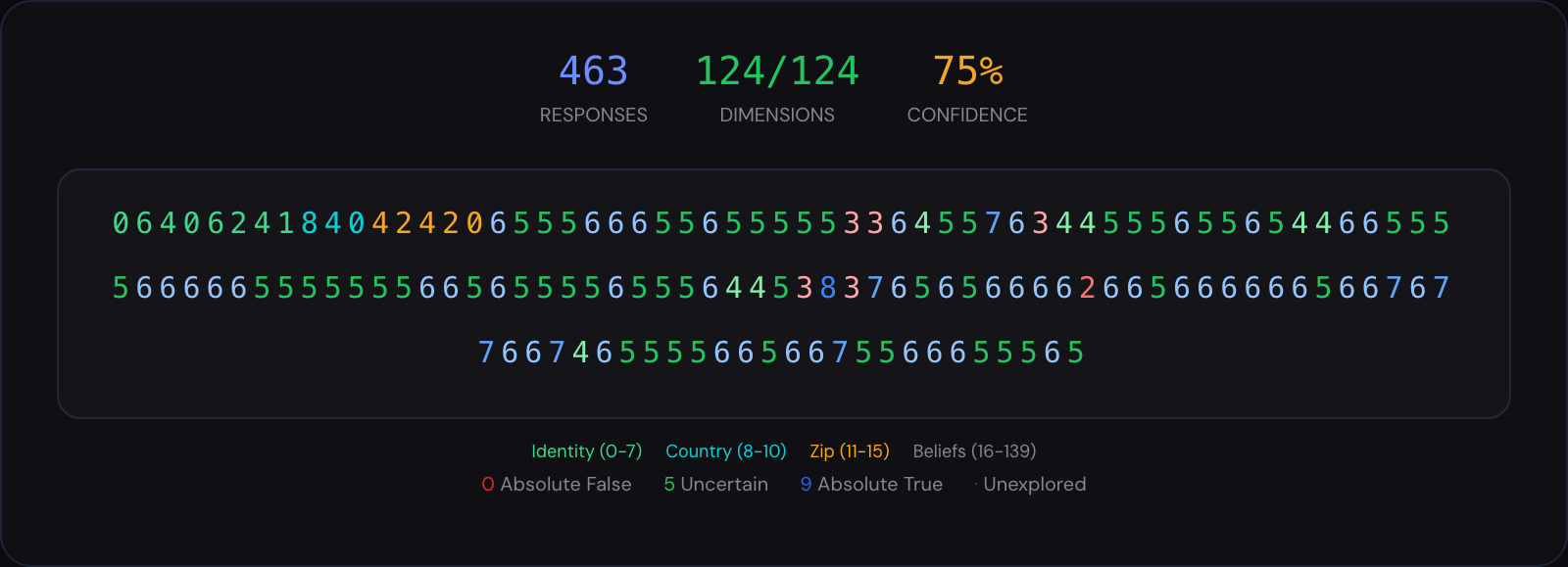
Over repeated measurements, Longitudinal Worldview Mapping is proposed as a way to track how patterns of responses move from more indeterminate to more stable over time. The architecture yields a 136-character Belief Genome Serial Key: a compact code summarizing an individual's responses across the 124 dimensions at a given point in time. Conceptually, this representation can be used to generate visualizations, such as triple-helix or 3D state-space plots, intended to aid interpretation, though these visual formats are currently at the prototype and design stage.
The Frontier
Entropy Harvesting and applied solutions.
The BGP framework aspires to capture richer data through what we term Entropy Harvesting™: collecting response patterns, probability estimates, and potentially micro-behavioral signals (e.g., hesitation times, changes under reframing) that classical instruments often treat as noise. The goal is to transform this variability into structured indicators of contextual sensitivity and internal conflict rather than discard it.
In principle, such data could support several applied avenues:
Aggregated BGP responses could provide population-level maps of belief configurations that underlie policy preferences and collective action, complementing existing survey and modeling tools.
Committed engagement could allow individuals to explore patterns of consistency, conflict, and change in their own beliefs over time, for personal growth and core understanding.
Encoded representations of individual belief states may offer one input to future approaches to transparent, personalized AI alignment, with potential applications in personal assistants, robotics, and broader AI systems. Realizing this potential will require rigorous empirical validation and robust ethical safeguards.
Pilot studies might test whether architectures like the Serial Key improve prediction of how people respond to new information or scenarios, relative to simpler baselines.
The Empirical Horizon
Architectural contributions and verification.
The Belief Genome Project does not claim to introduce a new underlying physics or probability calculus, and it makes no claim that minds or societies are literally quantum systems. It borrows the mathematics of quantum probability as a modeling language only. It represents an way to combine prior work, principally the behavioral tradition of quantum cognition and decision models, supported by quantum-like social modeling (including Social Laser Theory). It is also informed by, though does not depend on, the ontological proposals of Alexander Wendt and others. The BGP treats these proposals as interesting but contested and empirically unresolved. Building on this foundation, Meyers introduces seven architectural constructs:
- 01The 124-dimension belief architecture
- 02The Cognitive Qubit™
- 03The Collapse Event
- 04The Collapse Gap
- 05Entropy Harvesting™
- 06The 136-character Belief Genome Serial
- 07Longitudinal Worldview Mapping
Crucially, the BGP is presently a candidate architecture. While it draws on peer-reviewed mathematical and empirical work, the architecture as a whole, including its claims about midpoints, dimensional structure, and qubit-like units, requires systematic experimental testing. One proposed empirical program is to extend the established "QQ equality" framework to within-subject designs that stratify participants by their use of midpoints versus adjacent scale values, with the aim of testing whether midpoint-heavy responders exhibit distinctive context effects beyond what a classical mixture model would predict.
In this sense, the theoretical ingredients are available and a preliminary empirical blueprint can be articulated, but the decisive tests remain to be conducted. We invite collaboration from the scientific and technical communities to refine these designs, critically evaluate the underlying assumptions, and test whether architectures of this kind provide incremental explanatory and predictive value over existing models.
Selected References
- Busemeyer, J. R., & Bruza, P. D. Quantum Models of Cognition and Decision. Cambridge University Press.
- Busemeyer, J. R., & Yearsley, J. M. “Quantum cognition and decision theories.”. Trends in Cognitive Sciences.
- Wang, Z., Solloway, T., Shiffrin, R. M., & Busemeyer, J. R. “Context effects produced by question orders reveal quantum nature of human judgments.”. PNAS.
- Khrennikov, A. Social Laser and related articles on mean-field social laser models.
- Wendt, A. Quantum Mind and Social Science. Cambridge University Press.
- Donald, M. J. “We are not walking wave functions: A response to Quantum Mind and Social Science by Alexander Wendt.”. Journal for the Theory of Social Behaviour.
- Tversky, A., & Kahneman, D. “Judgment under Uncertainty: Heuristics and Biases.”. Science.
- von Neumann, J., & Morgenstern, O. Theory of Games and Economic Behavior. Princeton University Press.